What is EDI (Electronic Data Interchange)?

January 14, 2016

What is EDI? Electronic Data Interchange (EDI) is the computer-to-computer exchange of business documents in a standard electronic format between business partners.

By moving from a paper-based exchange of business document to one that is electronic, businesses enjoy major benefits such as reduced cost, increased processing speed, reduced errors and improved relationships with business partners. Learn more about the benefits of EDI here. »

Each term in the definition is significant:

  • Computer-to-computer– EDI replaces postal mail, fax and email. While email is also an electronic approach, the documents exchanged via email must still be handled by people rather than computers. Having people involved slows down the processing of the documents and also introduces errors. Instead, EDI documents can flow straight through to the appropriate application on the receiver’s computer (e.g., the Order Management System) and processing can begin immediately. A typical manual process looks like this, with lots of paper and people involvement:
    Manual EDI (Electronic Data Interchange) Document Exchange
    The EDI process looks like this — no paper, no people involved:
    EDI (Electronic Data Interchange) Document Exchange
  • Business documents – These are any of the documents that are typically exchanged between businesses. The most common documents exchanged via EDI are purchase orders, invoices and advance ship notices. But there are many, many others such as bill of lading, customs documents, inventory documents, shipping status documents and payment documents.
  • Standard format– Because EDI documents must be processed by computers rather than humans, a standard format must be used so that the computer will be able to read and understand the documents. A standard format describes what each piece of information is and in what format (e.g., integer, decimal, mmddyy). Without a standard format, each company would send documents using its company-specific format and, much as an English-speaking person probably doesn’t understand Japanese, the receiver’s computer system doesn’t understand the company-specific format of the sender’s format.
    • There are several EDI standards in use today, including ANSI, EDIFACT, TRADACOMS and ebXML. And, for each standard there are many different versions, e.g., ANSI 5010 or EDIFACT version D12, Release A. When two businesses decide to exchange EDI documents, they must agree on the specific EDI standard and version.
    • Businesses typically use an EDI translator – either as in-house software or via an EDI service provider – to translate the EDI format so the data can be used by their internal applications and thus enable straight through processing of documents.
  • Business partners – The exchange of EDI documents is typically between two different companies, referred to as business partners or trading partners. For example, Company A may buy goods from Company B. Company A sends orders to Company B. Company A and Company B are business partners.

Source credit:

What is EDI (Electronic Data Interchange)?


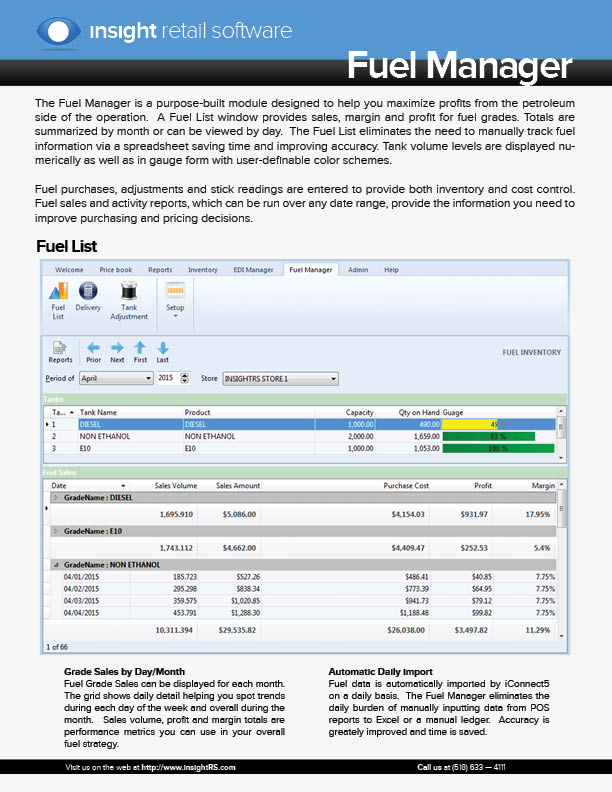
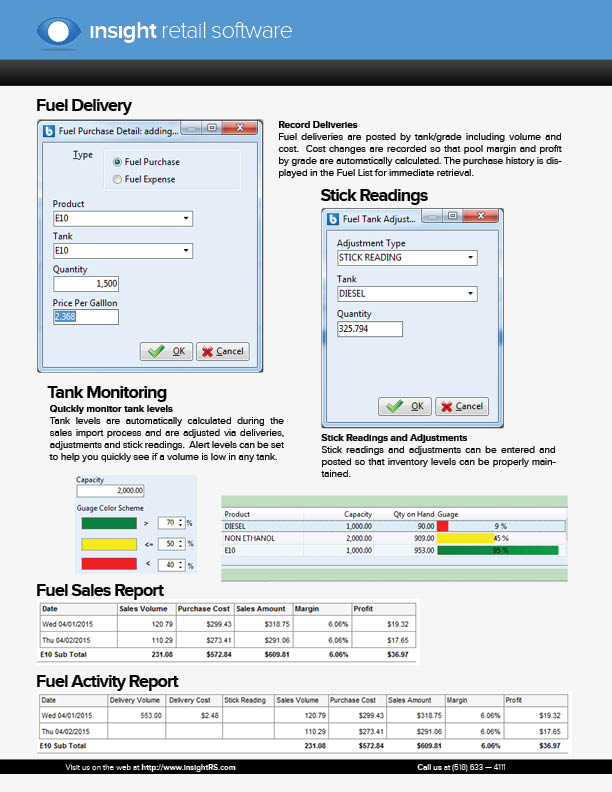
InsightRS Releases Fuel Manager

May 21, 2015

Call today for more information!

backoffice FuelManger Pg 1

backoffice FuelManger Pg 2.jpg


EMV – Let InsightRS help you get a head start.

May 8, 2015

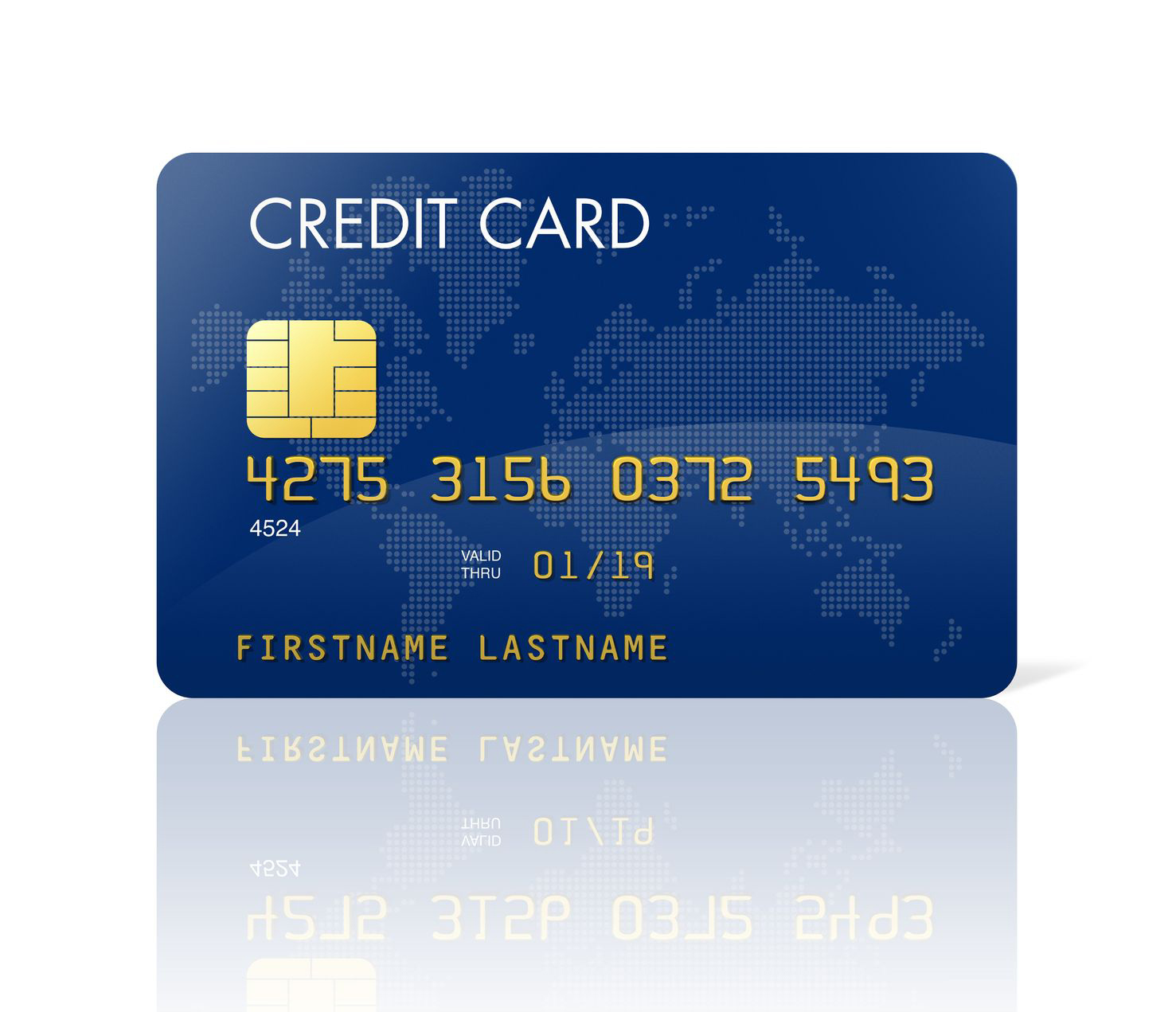
EMV – it’s what everyone is talking about.  Where do we begin?  Let’s start with a Glossary of Terms.

 EMV-Cardl

Chip and PIN

Chip and PIN is a brand name adopted by the banking industries for the two-part authentication process of inserting your chip card, and entering a PIN while the card is still inserted.


Chip and Signature

Chip and Signature is an alternative implementation that requires the cardholder to verify identity by signing a printed receipt, rather than entering a PIN.


Chip and Choice

Chip and Choice denotes the choice between Chip and PIN or Chip and Signature.


Contactless

Contactless payment is a change to the way debit or credit payment is handled when making a purchase. Contactless payment transactions require little to no physical connection between the card and the checkout device. Instead of “swiping” or “inserting” a card, the contactless card or fob is tapped on or held within an inch of a machine that reads the card, with the payment information is sent to the merchant wirelessly. Contactless credit and debit cards include a smart card chip.


EFT

Electronic Funds Transfer (EFT) is a system of transferring money from one bank account directly to another without any paper money changing hands.


EMV

EMV, which stands for Europay, MasterCard, and Visa, is a global standard for inter-operation of integrated circuit cards (IC cards or “chip cards”) and IC card capable point of sale (POS) terminals and automated teller machines (ATMs), for authenticating credit and debit card transactions.


EMV “Ready” devices vs. EMV Certified/Validated

EMV Ready devices refer to payment terminals that have the hardware capability and are level 1 certified to accept EMV transactions. When referring to EMV certified in context of POS applications, this would indicate that the hardware as well as the software/firmware resident on the hardware are certified as compliant and able to accept EMV transactions. In most cases the hardware and software combination would need to be certified with specific card brands (Visa, MC. Etc.) and with specific payment processors (First Data, Vantiv, Etc.).


Encryption

Encryption is the process of translating information into a code that can only be read if the reader has access to the key that was used to encrypt it. There are two main types of encryption—asymmetric (or public key) and symmetric (or secret key).


Insert and Pay

Insert and Pay is a term used often when describing a typical EMV payment transaction. Insert refers to the insertion of a chip enabled credit card into the EMV reader, or slot, on a payment terminal.


NFC

Near Field Communication (NFC) is a set of close-range wireless communication standards. NFC-equipped smartphones and other devices can exchange information with each other with a simple tap or wave.


PAT

An acronym used for Pay at Table. Typically referring to wireless devices accepting electronic payments such as Credit, Debit, etc. pay at table devices allow servers to accept and process payments without leaving the customers view.


Payment Unaware/ Out of Scope

The PCI PA-DSS applies to a payment application (as defined by PCI SSC) as follows: “The PA-DSS applies to software vendors and others who develop payment applications that store, process, or transmit cardholder data as part of authorization or settlement.” An out of scope, or payment unaware integration removes the POS application from PCI PA-DSS Scope as card data is never available to the POS application. An ‘Out of Scope’ solution for the integrated 3rd party POS application does not eliminate a merchant’s compliance responsibility to PCI DSS requirements.


Semi-Integrated

In a semi-integrated environment, the terminal or peripheral device used to capture credit card data is connected to the POS application, but the application used to actually process card payments is on a separate device.


Tap and Pay

Tap and Pay is another term commonly used to describe contactless payments.


Tokenization

Tokenization, when applied to data security, is the process of substituting a sensitive data element with a non-sensitive equivalent, referred to as a token that has no extrinsic or exploitable meaning or value.


Thanks to NCC for providing EMV education and Glossary of Terms at the NCC Dealer Conference 2015


It’s Spring!

March 31, 2015

It’s Spring!  That means spring forward, change the batteries on the smoke detectors and BACKUP YOUR DATA.  Backing up your data is like flossing your teeth.  You don’t have to floss them all – just the ones you want to keep.

backup-backup


What is Instagram and how can it help my business?

June 18, 2014

instagramInstagram has been around since 2011 and started as a way to quickly snap a photo, use their cool editing filters and put those pics out in the unfiltered world.  Instagram allowed its users to post photos without having to send friend requests or worry about much of anything.  But then in 2012 Instagram was purchased by Facebook and the bar started to rise.  Suddenly there were more cool filters, video capabilities and sharing between Facebook and other Social Media sites became easier and people started to jump on the bandwagon.  The users grew from teenage girls and college kids to movie stars, sports teams, TV Shows and businesses.   On March 25, 2014 Instagram announced having more than 200 million active monthly users beating out Twitter in terms of number of mobile customers in the US.  They also shared the fact that Instagram had already surpassed the ’20 billion photos shared’ mark.  Instagram became a household name.

So what is Instagram?  Here’s what google says:

  • Instagram is an online mobile photo-sharing, video-sharing and social networking service that enables its users to take pictures and videos, apply digital filters to them, and share them on a variety of social networking services, such as Facebook, Twitter, Tumblr and Flickr

With 200 million users out there, how can it help my business?  Good question!

  1. Showcase your business, showcase your merchandise

Facebook has friends, groups and pages.  Instagram’s feed is unfiltered and can be seen by anyone.  People (or let’s say ‘Shoppers)’  have a plethora of content available from friends and businesses they follow, and chances are – they want to see what you have available for sale!   So, keep your smartphone close and snap often!  Remember this, snap now, edit later if you need to.  You would be amazed at how wonderful a quick photo can look on Instagram!  A great way to advertise a new product, a new shelf placement or just something fun.  Once you become a pro, you’ll be snapping and posting with no real interruption to your day.

2.  Showcase yourself!

Everyday photos are a huge hit on Instagram.  Snap a photo of an employee with a new or fun product.  Better yet, have your employees post a photo on their Instagram showing the store, various products  or a special event.  Use the many cool filter effects to turn a quick snap into something that looks professional.

3.  Take Instagram behind the scenes

Shoppers get a warm and fuzzy connection when they get a taste of what everyday life is for store owners and store employees.  Share a few photos of trade shows, your participation in charity events,  trips to market, a video of food parings, etc.  Do whatever is relative to your business.  Let the customer know who you are [with limits of course].

#4.  # Hashtags !

What are they and what is their purpose?  I’ll let Wikipedia have the honors:

A hashtag is a word or an unspaced phrase prefixed with the number sign (“#”). It is a form of metadata tag. Words in messages on microblogging and social networking services such as Twitter, Facebook, Google+ or Instagram may be tagged by putting “#” before them,[1] either as they appear in a sentence, (e.g., “New artists announced for #SXSW2014MusicFestival”)[2] or appended to it.

Hashtags make it possible to group such messages, since one can search for the hashtag and get the set of messages that contain it. A hashtag is only connected to a specific medium and can therefore not be linked and connected to pictures or messages from different platforms.

#anyquestions #thatWASlong #annoyed #didNOTreadthat

Create your own hashtags to interact with your customers using your store name, a catch phrase, a charity event or a product name.  Make it fun and take advantage of this opportunity to reach new customers while staying connected to your current customers.  A great way to promote sales, events, products.

Take advantage of the CAPTION section by directing shoppers to your website or Facebook page where more information can be found. Don’t forget the videos!  A quick video from a customer or a video walk around the store or product demonstration videos are all great marketing tools.  With one click your photo or video capture can be pushed to your Company Facebook Page.  This gives you double coverage for the same effort.

Instagram is a fun and easy way to promote your business!  Get started today!

Good luck!

last try eye


Grow Your Business with Doyles Sheehan and Insight Retail Software

June 13, 2014


doyles logo

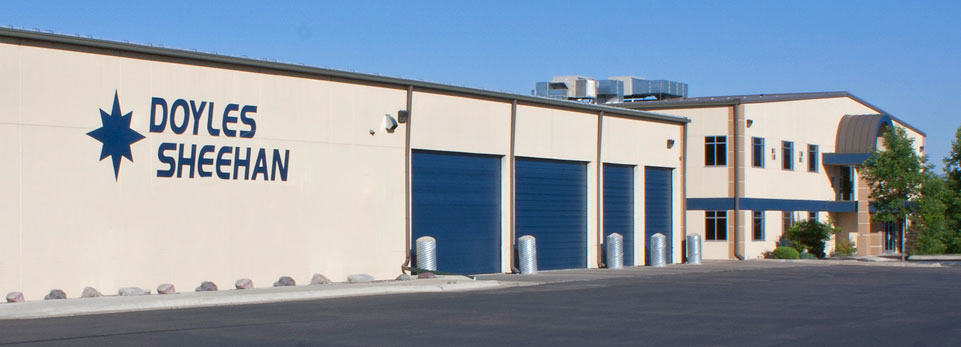
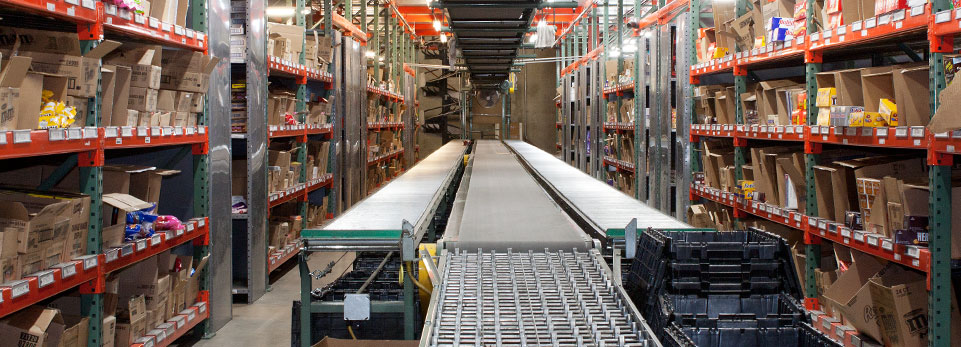
For more than 35 years, Doyles Sheehan has been a full-service distributor of food service, convenience and grocery products to a diverse customer base throughout the greater Northwest. DS has customers throughout Oregon, Washington, Idaho, Montana, Wyoming and North Dakota. They know how to compete effectively in the wholesale industry while always keeping their primary focus on the customer. I saw this first hand as InsightRS was invited to attend their Annual Tradeshow in Coeur d’Alene, Idaho.

This family-owned and family-operated company, is nothing short of top-notch. They reach far beyond simply selling products to their customers. They truly know the importance of traditional, dependable and superior service. They show daily that these core values, combined with sophisticated inventory, ordering, delivery and marketing systems are crucial to success for them and their customers.

So were does InsightRS fit in?

Electronic Data Interchange

or simply putEDI

EDI refers to the transfer of electronic data. Our EDI Module allows Doyles Sheehan customers to import their invoices directly into backOffice™ Software electronically from Doyles Sheehan. Gone are the days of spending HOURS on data entry to update pricing and receiving orders. Once imported, backOffice™ will identify new products received from Doyles Sheehan, any price or cost changes and the quantity shipped of each item. With the click of a button, new items are added, price and cost changes are made, and an order is created in the inventory module!

The low cost of this module added to backOffice™ Software will very quickly pay for itself in hours saved on data entry and missed price changes.  Join the other Doyles Sheehan customers and start growing your business the easy way!

Doyles Doyles TruckDoyles Warehouse  Doyles Sheehan

edi2


Windows XP set to Retire April 8, 2014 – Get Ready!

March 26, 2014

Windows XP


EDI Manager now available with your backOffice™ Software

August 28, 2013

23

WANT TO SAVE SOME SERIOUS TIME?

Insight Retail Software  is proud to announce the release of EDI Manager.  Almost every vendor can supply you with an electronic invoice of your order, and our new EDI Manager allows you to import these invoices directly into backOffice™.

Once imported, backOffice™ will identify new products received in the order, any price or cost changes and the quantity shipped of each item.  With the click of a button, new items are added, price and cost changes are made, and an order is created in the inventory module!

Just another way to run your business more effectively and save you time.

For more information please complete the form below.  Thank you!

Go back

Your message has been sent

Warning
Warning
Warning
Warning
Warning
Warning

Warning.


Proposed Federal Excise Tax on Cigarettes/Tobacco

July 9, 2013

Image

The proposed 2014 federal budget could mean bad news for c-store and retail stores who sell cigarettes and tobacco. The proposed budget includes a 94-cent per pack levy increase on cigarettes, with a comparable increase on all other tobacco products. The tax is expected to generate about $78 billion over the next ten years, but will undoubtedly add challenges for c-store owners who already struggle in the world of tobacco retailing. Learn More Here.
Luckily, backOffice™ can make this transition a little easier. With our Group Change feature, we make it easy to select all of your cigarettes or tobacco products at once and change your prices to reflect the tax increase. Group Change is perfect for “across the board” price changes like this one, and is a huge time saver compared to changing each price individually.

Image

If this tax ends up affecting your sales, and in turn your inventory levels, we’ve got you covered! Reorder using our “Order Based On Sales” feature over any time period, and backOffice™ will reorder your products based on quantity sold, making sure you always have what you need. Just another way to help you run your business more effectively, be successful, and Do Better.


Good Luck to Roy Morris ~Morris Marketing

June 28, 2013

Roy Morris has been a valued customer of IRSI since November, 2007 when he purchased backOffice™ to run his two stores in Butte, MT.  Roy is not only a customer but has become a good friend as we have exchanged stories and heard of his many adventures with ice boating during the winter months and river rafting during the summertime in their beautiful State of Montana.  Roy and his wife have sold their C-Stores and will no longer be a backOffice™ customer but will remain a friend.

Today in an email exchange he stated “You’ve been an important part of our retail success and I hope I can do you a good turn in the future.”  So we want to say GOOD LUCK to Roy and Deb as they head into their next chapter of life!  As Roy would say “Happy Trails” !

Looks like they are having fun!  Cheers Roy and Deb!
roy morris